We use cookies to make your experience better. To comply with the new e-Privacy directive, we need to ask for your consent to set the cookies. Learn more.


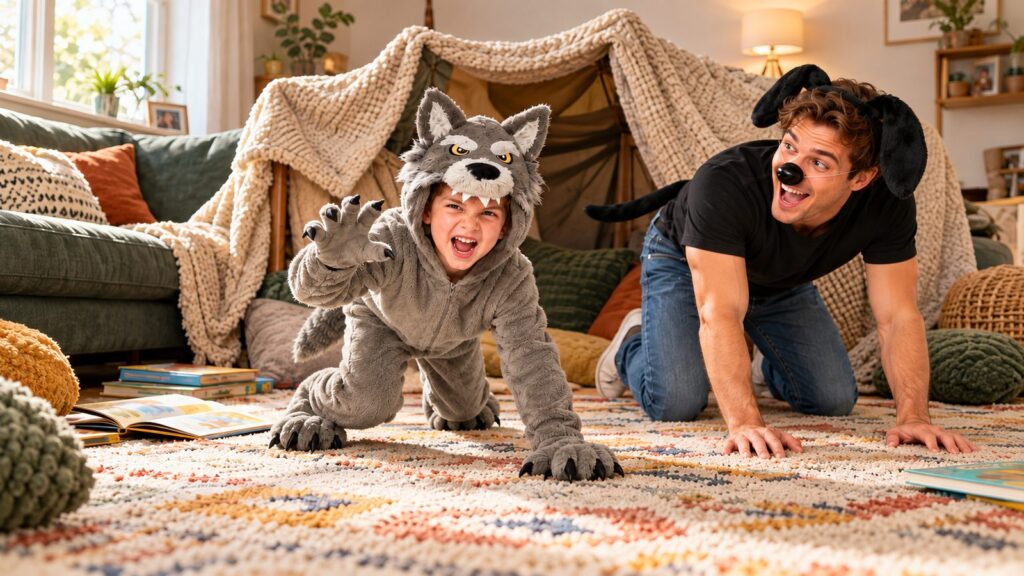
The benefits of dressing up for children show up in a handful of careful studies. In one experiment with 180 four- and six-year-olds, children who pretended to be a hard-working character, such as a superhero, kept at a dull task longest. Two small randomised trials found adult-led pretend-play sessions improved working memory and emotional self-control. A major review of the evidence calls pretend play one good route to development among several, so we treat a costume as an invitation to play, not a lesson.
Is dressing up good for children's development?
Dressing up is a brilliant way for children to play, and the best evidence points to a few specific gains. The American Academy of Pediatrics' report on play names dress up and make-believe as play that encourages more sophisticated language (Yogman et al., Pediatrics, 2018), though that report is expert guidance, not a trial. The trials are smaller, so the table gives each one's design, sample, and limit.
| Study | Design and sample | What it found | What it does not show |
|---|---|---|---|
| White et al., 2017 | Experiment, 180 children aged 4 and 6 | Children pretending to be a hard-working character worked longest at a 10-minute repetitive task | One study; the character condition differed in several ways, so the cause is not pinned down |
| Thibodeau et al., 2016 | Randomised trial, 110 children aged 3 to 5, five weeks | Adult-led fantasy play improved working memory more than non-imaginative play | Did not clearly beat the children's usual routine; small sample |
| Goldstein and Lerner, 2018 | Randomised trial, 97 four-year-olds from low-income families, eight weeks | Dramatic pretend-play games improved emotional self-control | Other social and emotional skills did not improve more than in the comparison groups |
| Lillard et al., 2013 | Review of the published research | Pretend play is linked with many good outcomes | No proof that pretend play is essential; for most skills the evidence is too thin to tell |
None of these studies compared a shop-bought costume with no costume. A tea-towel cape counts as dressing up, and so does one of our kids' fancy dress costumes; the pretending is what the research tested. Here for Halloween ideas instead? Our best kids' Halloween costumes guide starts there.
Can pretending to be a character help children keep trying?
Pretending to be a character helped young children keep trying in one well-known experiment. Researchers gave 180 four- and six-year-olds a repetitive computer task for 10 minutes, with an attractive video game available whenever they wanted a break (White et al., Child Development, 2017). Children asked to pretend to be a character they admired, such as a superhero, worked longest; children who thought of themselves by name came next; children who thought of themselves as "I" worked least. The six-year-olds kept going longer than the four-year-olds.
Read it with care. A summary reports that the character group was also given a prop, such as a cape, so more than one thing changed at once (BPS Research Digest), and a review podcast suggests the role play may simply have made a boring job more fun (SGEM #217). Either way, a character can turn a tidy-up or a long walk into a mission.
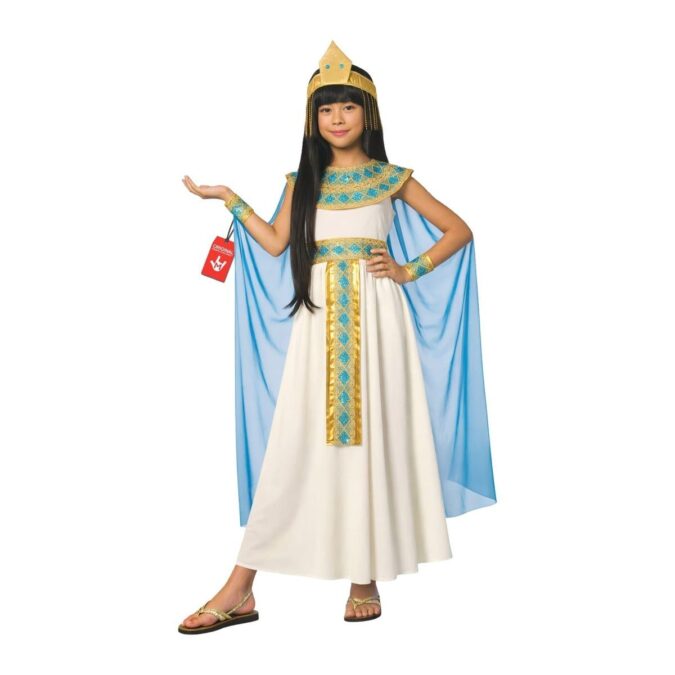
Girls Cleopatra Costume
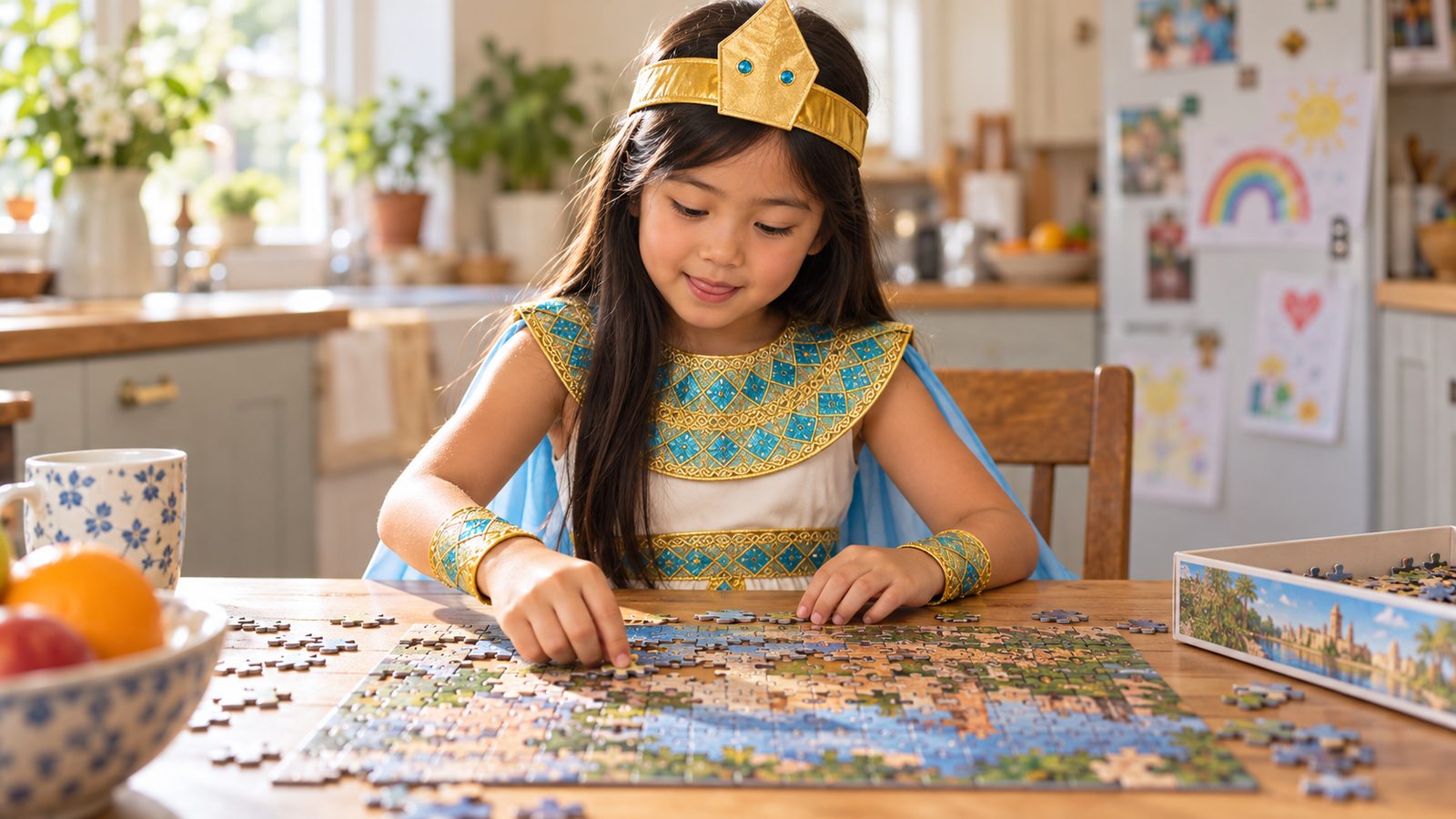
A character to admire does not have to be a superhero. The Girls Cleopatra Costume casts your child as a queen who ruled Egypt: a dress, a collar, a headpiece, a cape, and two wrist cuffs, in sizes S to XL. The wig and sandals in the photo are not in the pack. A grown-up who fancies playing the pharaoh can carry the Adult Gold Cobra Pharaoh Staff.
Does pretend play help children's thinking skills?
Adult-led fantasy play improved working memory in one randomised trial of 110 children aged 3 to 5, compared with non-imaginative play. Working memory, holding information in mind, is one of the thinking skills psychologists call executive function. For five weeks, children were assigned to fantasy pretend-play sessions run by a researcher, to non-imaginative play, or to their usual routine (Thibodeau et al., Journal of Experimental Child Psychology, 2016). The fantasy group's working memory improved more than the non-imaginative group's, but it did not clearly outscore the children on their usual routine (BPS Research Digest). The children most absorbed in the pretending gained most.
The sample is small, and the authors call fantasy play one of many routes to these skills. For a child who loves castles and quests, our knight, dragon, and wizard costume guide has more characters.
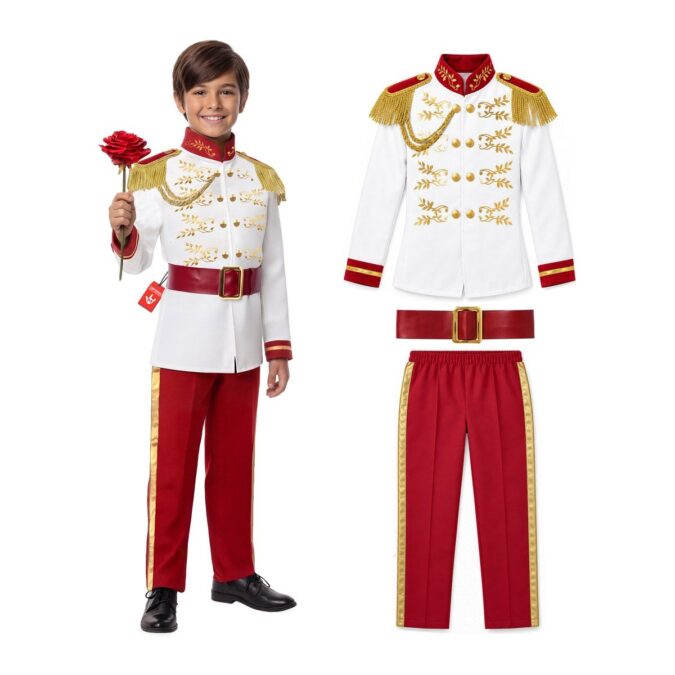
Boys Fairytale Prince Costume
From our 2026 range, the Boys Fairytale Prince Costume is a jacket, trousers, and a belt, with an elasticated waist and a hook-and-loop front that is easy to put on and take off, in sizes S to L for ages 4 to 12. The rose in the photo is a prop. A prince needs a kingdom, and a grown-up in the Adult King Crown can play the king who sets the quest.
Can acting like an animal help with big feelings?
Acting out animals and characters improved emotional self-control in a randomised trial of 97 four-year-olds from low-income families. Over eight weeks, one group played dramatic pretend games, such as moving and feeling like different animals, while the comparison groups had guided story time or block building (Goldstein and Lerner, Developmental Science, 2018). Only emotional self-control improved more than in the comparison groups; the other social and emotional skills the researchers measured did not.
Animals are also what many families reach for. Across kids' costumes sold on our UK site from 23 April to 25 October 2026, animal costumes outsold job and uniform costumes by roughly two to one, almost all of it in the Halloween run-up; from late April to the end of July, job costumes sold more (our own sales data). Our animal costume guide covers the wider range.
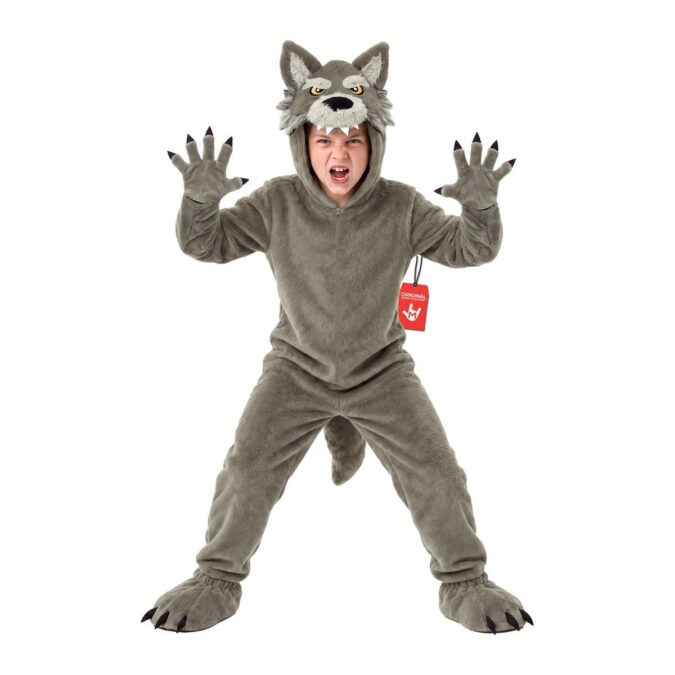
Kids Wolf Jumpsuit Costume
Prowling, howling, and creeping slowly are the kind of animal moves those games used. The Kids Wolf Jumpsuit Costume, from our 2026 range, is a loose-fit jumpsuit with an attached hood and a front zip, plus gloves and feet covers, in sizes S to XL for ages 4 to 14. The Adult Dog Ears and Tail Set lets a grown-up join the pack.
What does the research not show?
The research does not show that dressing up, or pretend play in general, is essential for a child's development. A major review found the evidence "does not support strong causal claims about the unique importance of pretend play" (Lillard et al., Psychological Bulletin, 2013). For reasoning, the authors conclude, pretend play is one of many routes; for most other skills the evidence is too thin to tell, and some studies suggest the benefits come from things that go along with pretend play.
- A child who prefers building, drawing, or running about is not missing out.
- No study here tested costumes against no costumes, so the costume is a prop, not the active ingredient.
- All three studies ran in the United States with small samples; the two trials lasted five and eight weeks, and none followed children for years.
We would rather tell you that than sell a costume as homework. Children enjoy dressing up, and the pretending may do some good along the way.
Where does dressing up fit in the early years framework?
Role play with props is written into England's early years goals for the end of Reception. The Early Learning Goal "Creating with Materials" expects children to "make use of props and materials when role playing characters in narratives and stories", and "Being Imaginative and Expressive" expects them to "invent, adapt and recount narratives and stories with peers and their teacher" (Department for Education, EYFS statutory framework, effective September 2026). The Department's non-statutory guidance goes further and tells Reception staff to provide related costumes and props for children's pretend play (Development Matters, 2023).
Which dressing-up ideas suit which age?
Dressing up can start as early as 2, and the costume can grow more detailed as the stories do. The NHS lists dressing up with old hats, bags, gloves, and scarves among play ideas from 24 months, and warns against loose cords, strings, or ribbons around the neck (NHS). All of our kids' products are safety tested by accredited labs. Development Matters says children generally start pretend play with "rules" at 3 or 4 (Department for Education), and the US Centers for Disease Control and Prevention expects most 4-year-olds to pretend to be something else, such as a superhero (CDC).
- Around 2 to 3: one easy piece over their own clothes, such as a hat, a tunic, or a bag, with nothing tied at the neck.
- 3 to 5: animals and fantasy characters they can move like, in costumes they can mostly put on themselves.
- 5 to 8: characters from books and school topics, often for World Book Day or a class assembly, with more pieces to get right.
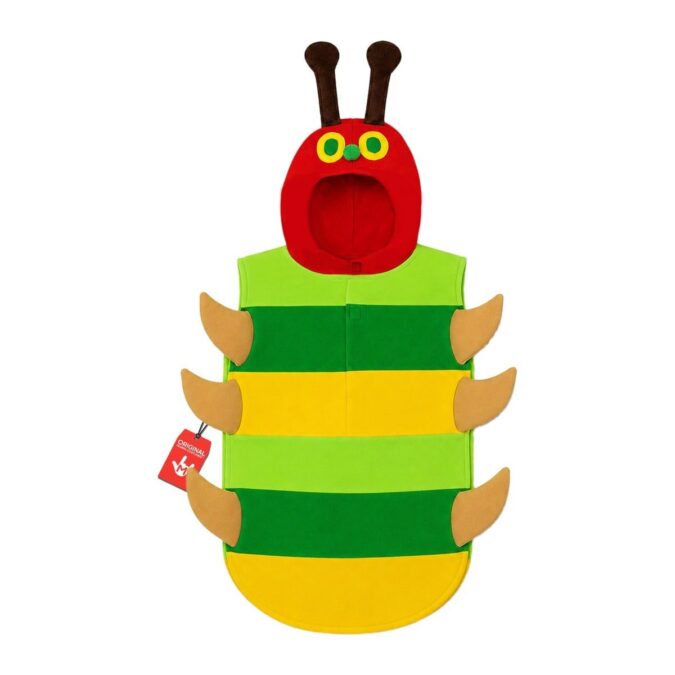
Boys Caterpillar Costume
From age 3, the Boys Caterpillar Costume is one striped green tunic with an attached red hood showing a friendly caterpillar face, so there is nothing extra to lose. It slips over everyday clothes and comes in five sizes, from 3-4 years up to 12-14. Add the Adult Butterfly Wings and Antenna Headband Set and a grown-up can play what the caterpillar turns into.
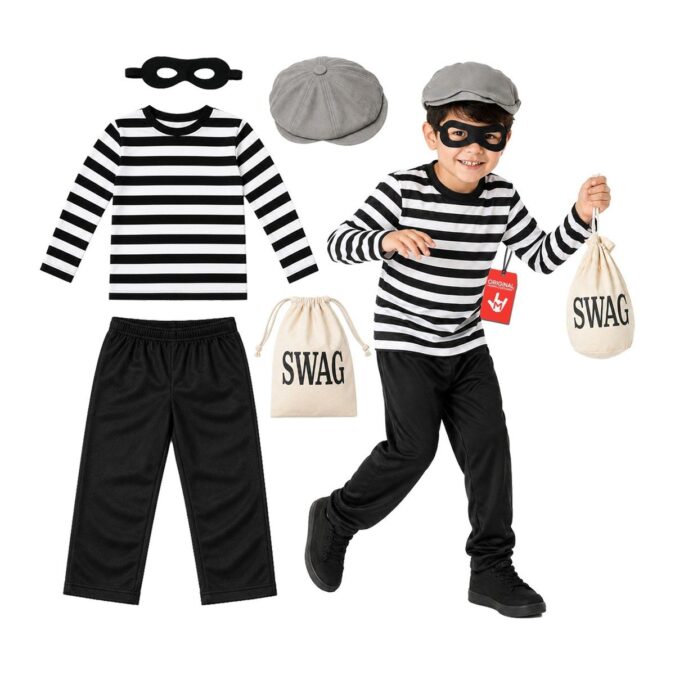
Kids Burglar Costume
Older children often want to play the baddie, and a storybook burglar is a cheerful one. The Kids Burglar Costume has five pieces: a stripey long-sleeve top, black trousers, a grey cap, a black eye mask, and a swag bag, for ages 4 to 14. Chasing is half the game, so the Mens Cop Kit Costume, in men's M to L, makes a grown-up the officer on the case. Our World Book Day guide for kids has more book characters.
How can grown-ups get the most out of dressing up?
Grown-ups get the most out of dressing up by joining in and letting the child lead. The American Academy of Pediatrics' play report, reaffirmed in 2025, says "the importance of playtime with children cannot be overemphasized to parents", and that the shared joy of play helps regulate a child's stress response (Yogman et al., 2018). Four habits help:
- Follow their story. Ask what happens next instead of directing the plot.
- Take a part. The pairings above give a grown-up a role in under a minute: the king, the officer, the butterfly, or the pack.
- Keep a dressing-up box. Old scarves, hats, and bags sit happily next to a costume or two.
- Let them dress themselves. Development Matters lists managing buttons and zips among the physical skills from birth to 3, so the zip on a wolf jumpsuit is practice too.
The kids' fancy dress picks here are sized by age, so check your child against each listing's size guide; the Caterpillar, Cleopatra, and Burglar listings say go up if your child is between sizes. All four of the Caterpillar, Cleopatra, Burglar, and Wolf listings say hand wash and air dry, and the Prince listing says follow the care label and air dry.
Every costume goes through over 30 measurement checks.
Frequently asked questions
What are the benefits of dressing up for children?
The clearest evidence is for persistence and self-control. In an experiment with 180 children aged 4 and 6, those pretending to be a hard-working character kept at a dull task longest (White et al., 2017), and two small randomised trials found adult-led pretend-play sessions improved working memory and emotional self-control. A major review says pretend play is one good route among several, not essential (Lillard et al., 2013).
At what age do children start dressing up?
It can start from about 2. The NHS lists dressing up with old hats, bags, and scarves among play ideas from 24 months, and the US Centers for Disease Control and Prevention expects most children to use things to pretend by 30 months and most 4-year-olds to pretend to be something else, such as a superhero (CDC). Our Boys Caterpillar Costume starts at 3-4 years.
Is role play the same as dressing up?
Not quite. Role play, or pretend play, is acting out being someone or something else; dressing up is role play with clothes and props. The studies in this guide tested pretending; props appear in some of the reports and are not described in others, so a costume is a helpful prompt rather than a requirement. Our kids' fancy dress range is one way to start the game.
Does my child need a shop-bought costume for World Book Day or play at home?
No. None of the studies here compared shop-bought and homemade costumes, and the main review finds no one kind of play essential (Lillard et al., 2013). A bought costume saves time on a school morning: our Kids Burglar Costume has all five pieces in the pack.
